Sunday, December 29, 2013

Rose Kia-Ora


In 1867 a Scotsman by the name of Lauchlan Rose patented the method used to preserve citrus juice without alcohol. A year later he established L. Rose & Co. with a factory in Leith to produce lime juice. The Merchant Shipping Act of 1867 required all ships of the Royal Navy and Merchant Navy to provide a daily lime ration to sailors to prevent scurvy. Rose's lime juice became almost ubiquitous, hence the term limey for British sailors. Rose established a presence on the Caribbean island of Dominica and became the main buyer of limes and lime products from across the island. The company contributed to the most prosperous period that the island experienced at the height of the green lime trade from 1903 to the mid-1920s and was one of the most successful agricultural companies ever to be based in Dominica.

In 1917 Rose launched a concentrated fruit soft drink called Kia-Ora. The name was taken from Kia ora a Maori language greeting which means literally “be well/healthy” and was first used for a lemon squash by Arthur Gasquoine in Australia. L. Rose & Co. began the production of  marmalade in the 1930s. The company continued to grow until it was taken over by Schweppes in 1957. The Kia-Ora brand became popular in the 1970s and 80s in the UK. It was widely available in cinemas where it was sold in rectangular plastic cartons that were supplied with a drinking straw.

Today, Rose's lime juice cordial and Kia-Ora are manufactured and distributed by Coca-Cola Enterprises Ltd.


by Mark Matlach

Saturday, December 14, 2013

W. & G. Brown

W. & G. Brown was a flour miller and manufacturer and supplier of cereals, established in 1812 in Derby where the company had a flour mill by the River Trent. The company advertised Brown's barley kernels which were used to make porridge or puddings for babies.

Brown's advertising from the 1920s and 30s claimed that their barley kernels were "invaluable for combating fever and kidney trouble", and "promoted health and natural beauty". Brown's flour mill was still operating in 1935, but little is known of the company after this date.

Advertisement

by Mark Matlach

Sunday, December 1, 2013

Pellatt & Co.

Pellatt & Co. was a glass manufacturing company established in London in 1802 by Apsley Pellatt and James Green under the name Pellatt & Green. The company had a glassworks known as the Falcon Glass House in Blackfriars, and a large showroom at St. Paul's Churchyard which became the principal glass shop in London during the Regency period. Pellatt & Green gained recognition for their glass illuminators (“deck lights”) for admitting daylight into internal parts of ships and buildings. Pellatt & Green was also the first in England to manufacture glass paperweights.

Apsley Pellatt died in 1826 and his son Apsley Junior took control of the company which he renamed Apsley Pellatt & Co. in 1831. The firm patented the process for encasing a medallion in glass, later called cameo incrustation or sulphides, however the company's main production was high quality cut crystal glass.

When Apsley Junior retired in 1855, his younger brother Frederick took over the business which was subsequently renamed Pellatt & Co.

In 1890 the firm returned to its former name of  Apsley Pellatt & Co. and in 1921 it was incorporated as a limited liability company which continued to trade into the 1930s.

Cut glass and sulphides had gone out of fashion in the 1850s and Pellatt & Co. turned to the production of engraved glass. The company began exporting glass products to wealthy Maharajas in India and this became a crucial part of its business.


The Pellatt & Co. showroom at St. Paul's Churchyard. For sale were chandeliers, decanters, paperweights, scent bottles and other glass products.

by Mark Matlach

J. W. & Co. and J W E R


J. W. & Co. Ltd. (John Wright & Co. Ltd.) and J W E R (John Wright & Eagle Range Ltd.)

John Wright & Co. was a manufacturer of gas appliances. The company was established in 1862 at the Essex Works in Aston, Birmingham and made gas stoves, cookers, gas fires and radiators. 


In 1900 John Wright absorbed the Eagle Range & Gas Stove Co. and the company became John Wright & Eagle Range Ltd. 

In 1937 the company exhibited at the British Industries Fair where the the firm displayed "Regulo" gas cookers, gas-operated hot water apparatus and large cooking apparatus for hotels and boarding houses. 

In 1961 the company was described as a manufacturer of kitchen ranges, gas fires, cookers and space heaters and had 1,200 employees.

Advertisement, 1903
 

by Mark Matlach

Sunday, November 24, 2013

Gundry & Sons

Gundry & Sons was a boot and shoe maker in London from at least 1820 until c.1953. The business was established at 1 Soho Square in central London as a "ladies shoemaker". The company gained a reputation for fine shoe making through  its participation at international exhibitions and by obtaining Royal Warrants. Gundry & Sons made the shoes for Queen Victoria for her wedding to Prince Albert in 1840. The business was taken over by John Lobb Ltd. some time after 1953.

Queen Victoria wore these Gundry & Son satin, slip-on shoes on her wedding day. The shoes are trimmed with six bands of ribbon and a small bow, with a leather sole and no heel. This style was very fashionable at the time. The shoes were much too small for the Queen to fit comfortably – she had 9 inch feet and the shoes were a size 3. It was not the done thing for ladies to show their feet and so they often wore shoes that were too small to make their feet as inconspicuous as possible.  

by Mark Matlach

E. A. Gibson


E. A. Gibson & Co. is a shipbroking company founded by Edward Aisbett Gibson in London in 1893. The company quickly established itself in the London broking scene and was actively engaged in the short sea trades around Europe, in timber, coal, coal tar products, and general cargo.

Gibson died in 1913 and  business virtually ground to a halt. Reconstruction of the E. A. Gibson company came in the form of Bill Green who became managing director in 1916. His first achievement was to corner the creosote market. Green then built up oil business for the company, specializing in the handling of crude oil. In a very short time the company became recognized throughout Europe as the principal brokers for crude sales.

During the 1930s, Gibson's tanker chartering operations were widened and the company expanded by opening offices in Paris and Morocco. After the Second World War, an aviation department was established.

In 1961 E. A. Gibson & Co. merged with dry cargo brokers Ferguson Wild to become E. A. Gibson Ferguson Wild. Today, Gibson's shipbroking service is international with a leading presence in London and offices in Houston, Hong Kong and Singapore.

Edward Aisbett Gibson

by Mark Matlach

Sunday, November 17, 2013

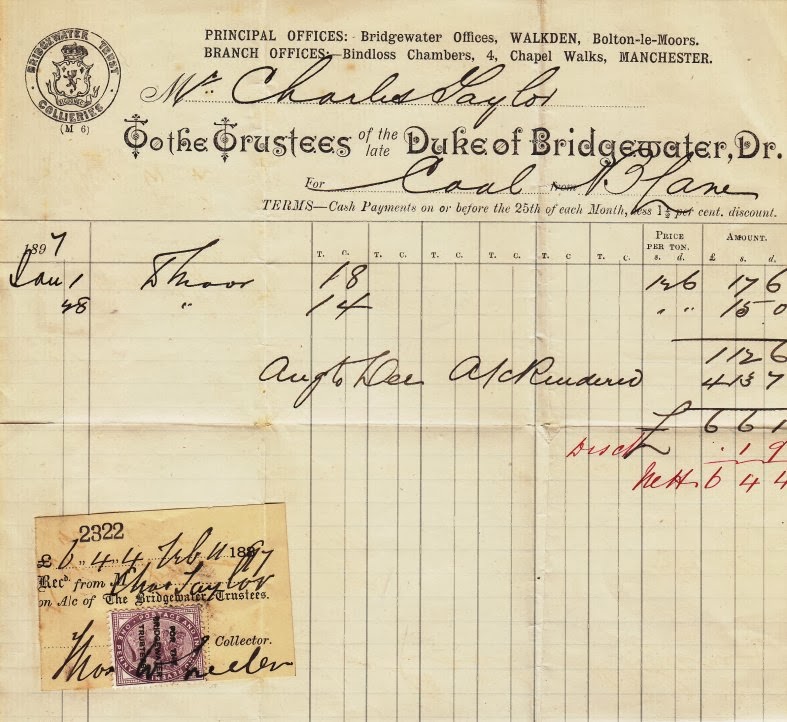
Bridgewater Trustees


Bridgewater Trustees
Earl of Ellesmere
Bridgewater Estates Limited


The 3rd Duke of Bridgewater owned extensive estates in Worsley, Greater Manchester. The Industrial Revolution was underway in mid-18th century  Britain and the Duke quickly set about exploiting the rich open coal seams on his land. There was great demand for increased and better transport to service the coal mines at Worsley and convey the coal to expanding markets. The Duke undertook the building of a canal which would eventually link Manchester with the Mersey Estuary. The Bridgewater canal was completed in 1776 and it is said to be the first true canal in Britain and the modern world.

The Duke died unmarried in 1803 and the Dukedom died with him. On his death, the Duke's estates, the canal and coal mines were placed in trust for the benefit of his nephew, Earl George Gower. By the terms of the will, control was vested in a body of three Trustees. With a continually changing personnel, this arrangement lasted for a 100 years.

In 1903 the terms of the Duke's will expired and all the remaining Bridgewater interests passed into the absolute ownership of Francis Charles Egerton, the 3rd Earl of Ellesmere. On the death of the 3rd Earl in 1914, his son John Francis Egerton succeeded him as the 4th Earl of Ellesmere and inherited all his estates and financial interests.

In 1923 the 4th Earl of Ellesmere sold off his estates to a syndicate of Lancashire businessmen who formed a new company called Bridgewater Estates Ltd. Following the nationalisation of the coal industry in 1942, Bridgewater Estates Ltd. surrendered its mine leases to the Coal Commission.  In the 1960s the company owned approximately 7,000 acres of land. Bridgewater Estates made further land purchases during the 1970s, including the Thornley Estate, at Longbridge near Preston. In 1984 the company was acquired by Peel Holdings Ltd. and its name was changed to Peel Estates Ltd. In 1990 the company name was changed to Peel Investments (North) Ltd. after amalgamation with other companies in the Peel Group.


by Mark Matlach