Saturday, January 22, 2011

Samuel Montagu & Company

Montagu Stanley was born in 1832 in Liverpool. While he was still a young child, his parents reversed his names, for reasons best known to themselves, and he became Samuel Montagu.

At the age of 15 Samuel Montagu moved to London and began his business career in the City, one which would span more than six decades. His first position was with his brother-in-law's money exchange business, where he learned the intricacies of the profession. Montagu left three years later to become the manager of the London branch of a French bank called Monteaux. However Montagu was determined to go into business for himself and he did not stay at the bank for long. In 1852, at the age of 20, Montagu borrowed £5000 from his father to finance an international bullion, money exchange, and bill collection service that he formed with his elder brother, Edwin Samuel. The new company was called Samuel & Montagu though the name was changed to Samuel Montagu & Company in 1877.

For the next twenty years, Samuel Montagu & Company was the undisputed leader in the silver bullion trade. It was one of the four firms which participated in the daily fixing of the silver price. By the 1870s the company was financing loans for European governments and was instrumental in making London the centre of the international money market.

Samuel Montagu was also very active in politics (he was created Baron Swaythling in 1862), and a philanthropic member of the Jewish community until his death in 1911.

By Mark Matlach

Sunday, January 16, 2011

General Electric Company Limited

The General Electric Company (GEC) was a major British company involved in consumer and defence electronics, communications, and engineering.

GEC traces its origins to G. Binswanger & Co., an electrical goods wholesaler established in London during the 1880s by a German immigrant named Gustav Binswanger. In 1886 Binswanger was joined by fellow immigrant Hugo Hirst and the company name was changed to The General Electric Apparatus Company. The firm established a factory in Salford and began manufacturing telephones, electric bells, ceiling roses, and switches.


Hugo Hirst

In 1889 the business became General Electric Company Limited. The firm was expanding rapidly, opening new branches and factories and trading in "Everything Electrical", a phrase that was to become synonymous with GEC. In 1893 GEC decided to invest in lamp manufacture. The company led the way in lamp design and the burgeoning demand for electric lighting was to make GEC's fortune. In 1902 GEC's first purpose-built factory, the Witton Engineering Works, was opened near Birmingham.


The outbreak of The First World War transformed GEC into a major player in the electronics industry. The company was heavily involved in the war effort, with products such as radios and signal lamps. During The Second World War, GEC was a major supplier to the military of electrical and engineering products. GEC continued to expand after the War and by 1983 the company had become Britain's largest private employer, with about 250,000 employees.

GEC was renamed Marconi Corporation Limited in 1999 after its defense arm was sold to British Aerospace. In 2005 Ericsson purchased the bulk of Marconi and the remaining businesses were renamed Telent.

By Mark Matlach


There were at least three different General Electric overprints spanning the years from SG 421 to SG 518. The center stamp above is a rare combination of a commercial overprint and a perfin.

Saturday, January 15, 2011

The Times

The Times is a daily national newspaper in the UK. It is generally regarded as a serious publication with high standards of journalism. The paper is the originator of the ubiquitous Times Roman typeface, originally developed for its legibility in low-tech printing. The Times currently has a daily circulation of 502,000 copies.

The Times was founded by John Walter on 1st January 1785 as the Daily Universal Register, with Walter in the role of editor. Walter changed the title after 940 editions on 1st January 1788 to The Times. The newspaper was to remain in the hands of John Walter's family for the next 120 years. The Times used contributions from significant figures in the fields of politics, science, literature and the arts, to build up its reputation. For much of its early life, the profits of The Times were very large and the competition minimal, so it could pay far better than its rivals for information or writers.

In 1817 Thomas Barnes became general editor. Under his stewardship and that of his successor, J.T. Delane, the influence of The Times rose to great heights, especially in politics and amongst the City of London. The Times was the first newspaper to send war correspondents to cover particular conflicts. W.H. Russell, the paper's correspondent with the army in the Crimean War, was immensely influential with his dispatches back to England.

Since 1981 The Times has been owned by Rupert Murdoch's News International. Murdoch quickly introduced new technology and efficiency measures. The Linotype printing process which had been used to print The Times since the 19th Century, was phased out and replaced by computer-input and photo-composition. This allowed the printing staff to be reduced by half. The Times had been printed in broadsheet format for 219 years but switched to tabloid size in 2004 partly in an attempt to appeal to younger readers and partly to appeal to commuters using public transport.


By Mark Matlach

The Times used commercial overprints from at least SG 421 to SG 543bd. There are three patterns over that period, which have small differences in font and spacing.

Sunday, January 9, 2011

Frederick Braby & Co. Ltd.

Frederick Braby & Co. was a manufacturer of a vast range of products made from tin, zinc, lead and iron. The firm was established at Euston Road, London in 1839 and became a limited company in 1865.

As the company expanded factories were established in Deptford (1866), Liverpool (1871), Glasgow (1875), Bristol (1896), and Falkirk (1899).

Photograph of Braby's Eclipse Works Glasgow circa 1910
The man in the centre of the foreground is a foreman. The "hard-hats" as they were called, were not popular among the working men, and the bowler hat was not only a symbol of the foreman's position but protected him from rivets and other objects "accidentally" dropped by workers from above.


The depression following The First World War resulted in the closure of the Glasgow Works, and Frederick Braby & Co. Limited moved to Crayford. In 1959 Braby's acquired Auto Diesels Limited ( manufacturers of generating sets ) and moved to Uxbridge with the new company name of Braby Auto Diesels. Products being manufactured at this time included wire netting, aluminium roofing, galvanised tanks, cisterns, steel pipes, oil tanks, wheel barrows and metal furniture.

Braby Auto Diesels was acquired by the Economic Group, who were manufacturers of gas appliances, in 1970. The company closed down in 1986 and the Uxbridge premises were demolished. The site is now a business park.


By Mark Matlach


The image above shows an early version of the Braby overprint and an example of the overprint from the top of the article which is rotated 180°.

Carters Tested Seeds Limited

Carters Tested Seeds was a company of seed and grain merchants, established in 1804 in High Holborn, London, with the initial trading name of James Carter, Dunnet & Beale. In 1879 the company registered its first trademark "Trocadero - Carters Grass Seeds", for agricultural and horticultural seeds.

In 1910 the business was moved from High Holborn to Raynes Park in South West London. Magnificent new headquarters were built, along with glass houses, seed trial gardens and packing and mailing premises. Carters established a nursery at nearby Perry Hill, which grew into one of the first bedding-plant nurseries of the day. The nursery had six span-roofed houses, each 150 feet long and 20 feet wide, in each of which 100,000 bedding-plants could be arranged in different stages of growth. Over 100 staff were employed to maintain the nursery. In 1930 the business went public with the trading name of Carters Tested Seeds Limited.


In 2008 Carters Tested Seeds Limited was taken over by Vilmorin, an international company which is the largest packet seed distributor in the world.

By Mark Matlach

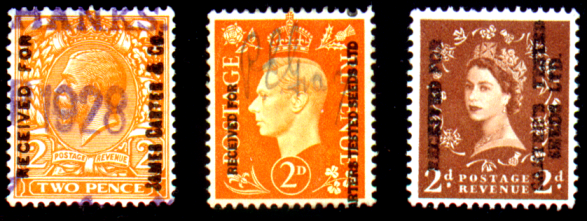
It is likely (but not certain) that the first of the three overprints above is from the company that would come to be known as Carters Tested Seeds. The third overprint is on SG573.

Friday, January 7, 2011

Catesbys Limited

In 1865 Edward Catesby opened a carpet and linoleum shop in Marylebone, London. Twenty years later he relocated to a large new store built at Tottenham Court Road in the West End. The new store was completed in 1904. It was designed by the architect Henry A. Whitburn in a flamboyant Renaissance style.

In addition to carpets and linos, Catesbys began to sell linens, hardware and pottery. By the 1930s Catesbys was regarded as having the best stock of linoleum in London. The store closed down in 1958.


Former Catesbys Carpet Shop, Tottenham Court Road

By Mark Matlach


Catesbys used commercial overprints into the 1950s.


Imperial Ottoman Bank

The Imperial Ottoman Bank was founded in 1856 in the capital of the Ottoman Empire, Istanbul. It was a joint venture between British interests, the Banque de Paris et des Pays-Bas of France, and the Ottoman government. The opening capital of the bank consisted of 135,000 shares, 80,000 of which were bought by the British group, 50,000 by the French group and 5000 shares were allocated to the Ottomans.

The Imperial Ottoman Bank carried out the functions of a state bank. In 1875 the Bank was authorised to control the budget and the expenditures and incomes of the state. The bank was also involved in financial support for public works and railways, such as the Beirut Port and the Beirut to Damascus railway line.

The First World War was very damaging for the Imperial Ottoman Bank. It lost credibility with the Ottoman government because of its British and French shareholders, and on the other hand, the British and French governments considered it as an institution belonging to the enemy. After the War most of the Bank's branches had to be closed, while new branches were established in the Near East between 1920 - 1930 to serve British interests.

After the proclamation of the Republic of Turkey in 1923, the Imperial Ottoman Bank became the Ottoman Bank. The Bank's role as a state bank remained until 1933 when it became a commercial bank and finally in 1952 it turned into a private institution.

In June 1996, the Ottoman Bank was sold to the Dogus Group, from which point its banking activities were centered primarily in Turkey. In 2001 the Ottoman Bank became part of the Garanti Bank.


By Mark Matlach