Sunday, November 13, 2011

M. Huntbach & Co. Ltd.

In 1876, Michael Huntbach opened a small drapery shop in Lamb Street in Hanley, Staffordshire. He was helped in the running of the store by his wife and his two sisters. As the business prospered, Huntbach extended the shop by acquiring the neighbouring premises on both sides of Lamb Street, creating a large wholesale and retail drapery store. The business was Hanley's first superstore and occupied more than 20,000 square feet of space and employed 300 permanent staff.

Advertisement 1895

Huntbach was also a politician. In 1890 he became mayor of Hanley. His most notable achievement while in office was that he created the first public park in Hanley. Going to the park on a Sunday became the highlight of the week for Hanley residents. It was a formal occasion and it seems that you were not allowed to enjoy yourself. Sweets and cigarettes were banned from sale and the children's playgrounds were locked. Michael Huntbach died in 1910, although his company continued until at least the 1920s.


by Mark Matlach

John Dickinson & Co. Ltd.

John Dickinson & Co. was a paper manufacturing business that went on to become a leading British stationery company.

The company was founded by John Dickinson in 1804 in Apsley, Hertfordshire. Dickinson invented a continuous mechanized paper-making process that he patented in 1809. He established paper mills at Apsley, Nash Mill, and Croxley in Hertfordshire. The river and canal at Apsley and Nash Mill provided power for the mills and transport for materials and product. In just a few years, John Dickinson & Co. became renowned for its production of tough, thin paper, which was used for Samuel Bagster's Pocket Reference Bible.

In 1830, John Dickinson patented silk-thread paper for bank notes and later adopted the technology for postage stamps. In Britain, the paper was used for the high value embossed stamps (1847–1854).


In 1850, John Dickinson & Co. started mechanical manufacturing of gummed envelopes for the first time. By 1876, the company was producing 3 million gummed envelopes per week. In 1858, John Dickinson retired, handing over the business to his nephew, John Evans. Dickinson died in January 1869 having refused to call in his doctor on the grounds that he was too ill to see anyone!

John Dickinson & Co. adopted the lion brand as the company logo in 1910 and, in the following year, the Basildon Bond brand was established, which by the 1930s had become the bestselling notepaper in the UK. From 1917-1930, the company expanded overseas; ultimately there was a network of manufacturing sites and sales offices in thirteen countries around the world.

In 1966, John Dickinson & Co. Ltd. merged with E. S. & A. Robinson Packaging, creating the Dickinson Robinson Group (DRG), one of the world's largest stationery and packaging companies. In 1990, Biber Holdings of Switzerland acquired DRG and the name of the company was changed to John Dickinson Stationery Ltd. In 2005 the company was purchased by Hamelin and restyled as Hamelin Brands and relocated to new, purpose-built premises in Suffolk in 2008.

by Mark Matlach

Frederick Finn & Sons Limited

Frederick Finn & Sons Ltd. (also known as Finn's Stores) was a wholesale grocery business established at 21/24 St. Margaret's Street, Canterbury.

In 1903, the company was described as "wholesale grocers and provision merchants, high class tea and coffee merchants, wholesalers of patent and homeopathic medicine, ironmongers, ham and bacon curers, and wholesalers of tools and traveling requisites."

Frederick Finn & Sons Ltd. traded until at least 1917.

Frederick Finn & Sons Ltd. in 1889

Although the company was active until at least 1917, I am aware of overprints only on the 1881 1d Lilac. There are two types: the one shown and also "FREDERICK FINN, / CANTERBURY." (style H2a)

by Mark Matlach

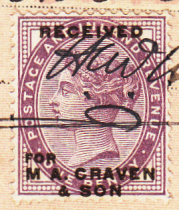
M. A. Craven & Son

M. A. Craven & Son was a confectionery manufacturer established in York in 1803 by Mary Ann Craven.

The Ebor Confectionery Works (also known as the French Almond Works) manufactured sugared almonds, pastilles, gums, mints, boiled sweets, toffees and nougat.


Advertisement 1949

The company traded until at least 1966.

Between 1976 and 1981, the Ebor Confectionery Works were demolished. As the factory was being torn down, the remains of a Viking house was discovered, its wooden fabric astonishingly well-preserved in the wet soil. Excavations on the site provided a wealth of artefacts and knowledge about the Viking age, demonstrated in York's famous Jorvik Viking Centre. The Coppergate Shopping Centre now occupies the enlarged site.


by Mark Matlach

Sunday, November 6, 2011

Marshall & Snelgrove

Marshall & Snelgrove was a department store situated on the corner of Oxford Street and Vere Street in London's West End.

The business was begun in 1837 when James Marshall, in partnership with a Mr. Wilson, opened a clothes shop at 11 Vere Street. The partnership was expanded to become Marshall, Wilson & Stinton. In 1848 when Stinton retired, John Snelgrove, an assistant in the firm, became a partner and the company's name was changed to Marshall & Snelgrove. The business grew and new premises were established in 1851 on the corner of Vere Street and Oxford Street. The new store sold a wide range of carpets, linoleum, soft furnishings and clothing. An air of exclusivity was cultivated by maintaining an on-site couturier workroom.

James Marshall retired in 1871. His son, James C. Marshall, and John Snelgrove continued with the running of the company. Marshall & Snelgrove opened branches in such fashionable resorts as Scarborough and Harrogate to enable their customers to shop whilst on holiday. Later, more branches were opened in Birmingham, Manchester, Southport, Bradford, Sheffield, Leicester, Leeds, and York.

Marshall & Snelgrove began to suffer financial losses following the outbreak of the First World War. By 1916 a working relationship had been established with Debenhams in order to preserve the business in the war economy. There was a full merger between the two companies in 1919.

During the 1960s, some of the Marshall & Snelgrove branches were closed and in 1973 the Oxford Street store was completely rebuilt. The strengthening of the Debenhams brand name meant that all Marshall & Snelgrove stores became Debenhams stores in 1973.

Marshall & Snelgrove used the company initials to overprint their stamps. The overprints appear only on Queen Victoria stamps, although there are varieties in the positioning of the overprint, font type and the use of full stops.

by Mark Matlach

Morgan Crucible Co. Ltd.

The Morgan Crucible Co. Plc. is currently one of the world leaders in advanced materials technology, specializing in the design, manufacture, and marketing of ceramic and carbon products. These are used in a wide range of applications from transport and telecommunications to fire protection and medical instruments.

The company was established in 1855 when William Vaughan Morgan purchased a hardware and druggist business in London and began trading under the name of Morgan & Rees. William was soon joined by his brothers Thomas, Walter, Octavius, Septimus, and Edward. Crucibles (which are pot-shaped containers in which metal or glass can be melted) were among the items that the brothers sold. The initial success of the company prompted the Morgans to buy manufacturing rights to the superior American crucible manufactured by Joseph Dixon & Co. In 1857, a small factory in Battersea, south-west London, was purchased and the company adopted the name Patent Plumbago Crucible Co. By the 1880s it was renamed Morgan Crucible Co. and enjoyed a reputation for being the world's largest crucible manufacturer. The company became limited in 1890.


At the turn of the 20th century, Morgan Crucible Co. Ltd. ventured into the manufacture of carbon brushes. Cities throughout the world were soon using the brushes for their railway and tram systems. In the following years the business continued to grow and venture into new areas, eventually becoming the massive industrial giant it is today.

by Mark Matlach

Webb & Sons

The origins of Webb & Sons can be traced to the middle of the 19th century, when Edward Webb was a successful agricultural seeds merchant trading from Wordsley near Stourbridge in the West Midlands. By the end of the century, Webbs seeds had become a household name and Webb & Sons were appointed seeds-men to every monarch in succession from Queen Victoria to Queen Elizabeth II.

Webb & Sons took over the Saltney bone manure works of Proctor & Ryland c1894. Webbs expanded the plant to such an extent that by 1910 it was Saltney's second largest business. At the beginning of the 20th century, Edward's grandson William, took control of the company and purchased Astwood Farm in Wychbold, Worcestershire in 1925. There, both agricultural and horticultural seeds were trialled to assess their quality.

Webb & Sons Bulb Catologue Cover 1888

During the Second World War, Webb & Sons was a primary supplier of grass seeds and fertiliser for airfields. The seeds used for this purpose were chosen to withstand heavy aircraft traffic. Webbs also assisted in the camouflage of landing strips.

During the late 1960s and early 1970s, the English seed trade was transformed by a series of mergers. Webb & Sons joined with Bees and moved to Chester, leaving the Wychbold site occupied by a fledgling garden center. In 1971, current owner (Richard Webb, who is the great grandson of Edward Webb) purchased the site and began the development of Webbs as both a garden center and nursery.

by Mark Matlach